

Current configuration view
The current Dubot app lets a team configure an agent’s model, reasoning budget, and customer-facing behavior. Capabilities and actions are attached after the agent is created. This is the configuration plane, not a Browserbot execution surface.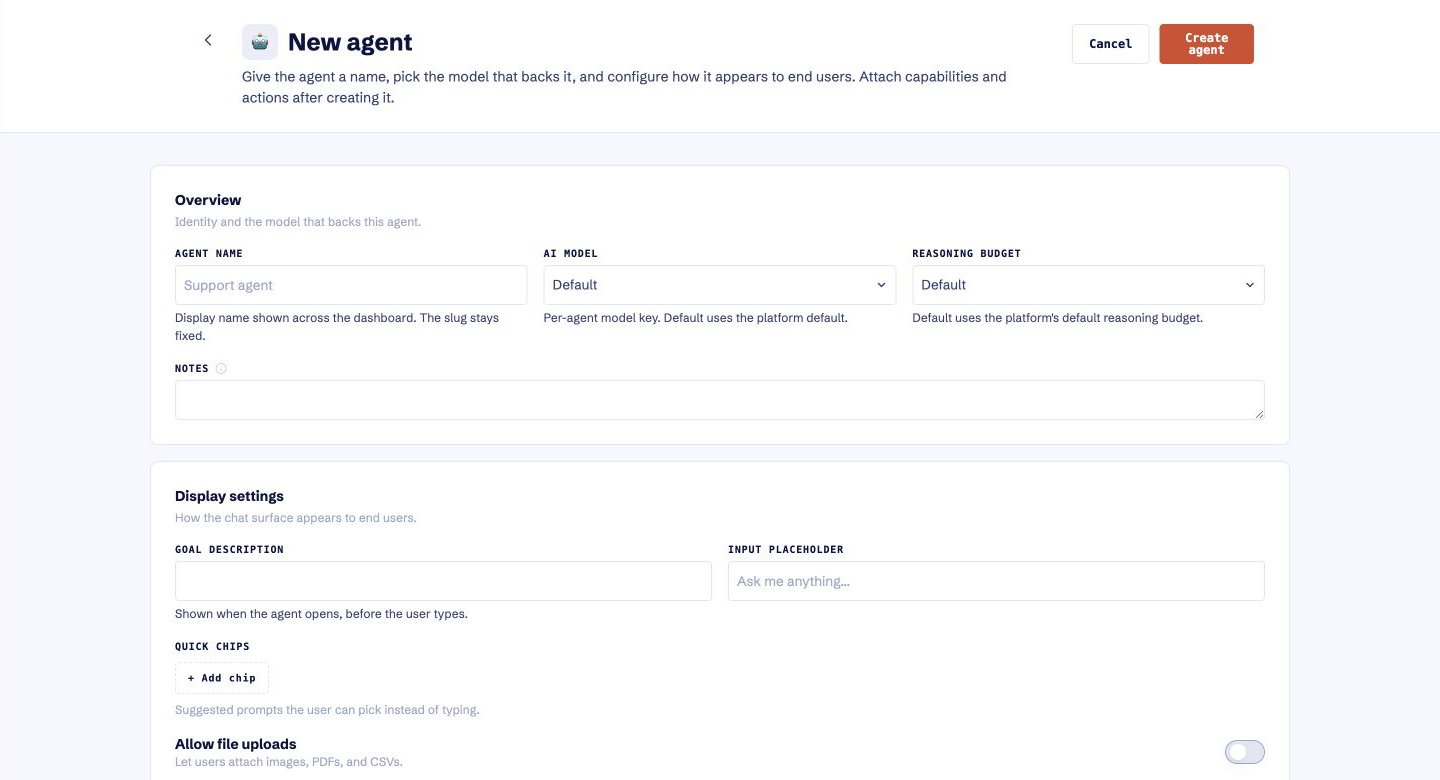
The action loop
1
Receive intent and context
A support AI, agent, or in-product surface passes the customer request and the context needed to act.
2
Resolve to an approved capability
Dubot matches the request to a capability the business has reviewed. If no suitable action or journey exists, it stops or falls back rather than improvise a new write.
3
Check state and policy
Dubot evaluates the current product state, the allowed scope, and any required confirmation before continuing.
4
Do, or fall back to show
When an approved action exists and is reachable, Dubot performs it. When it does not, Browserbot or the contextual sidepanel guides the customer to the right place and shows them the next step.
5
Verify the result
Dubot checks for the expected state change and reports whether the request was completed, needs attention, or could not continue safely.
Runtime model
Two ideas shape how Dubot behaves once a request is approved.Do, falls back to Show
Whether Dubot acts or guides is decided at runtime, not fixed in advance. If the approved action is available it runs; otherwise Dubot navigates the customer to the right screen and shows them the step. The customer is never left at a dead end.
Intent, not selectors
Navigation targets are stored as intent, such as “the settings link in the primary navigation,” and resolved against the live interface at runtime by a fast model, with resolutions cached and retried. This avoids brittle stored selectors that break when a product’s markup changes.
The runtime model describes intended behavior. The contextual sidepanel and runtime knowledge retrieval are in active development.
Control model
Dubot is designed around bounded, approved building blocks rather than open-ended control.Current status
Available for customer evaluation
Available for customer evaluation
Agent configuration, attaching capabilities and actions, knowledge ingestion, Browserbot-based interaction, explicit approval points, and outcome verification can be evaluated with a focused first use case.
Coming next
Coming next
The contextual sidepanel, runtime knowledge retrieval, reusable governance controls, and support-platform connection patterns are in active product development.
Not promised here
Not promised here
General availability, a public API, prebuilt connectors, deployment models, and formal compliance claims are not implied by this documentation.